Shaykh Umar Vadillo

Thought Leadership

Shaykh Umar Ibrahim Vadillo

Muamalat
Tasawwuf
Amal of the Ahl al-Madinah

"Restoring Muamalat requires rebuilding the institutions that make lawful trade possible."

Podcast & Media
Insights into Muamalat and Sufism
Loading episodes...
Profile Summary

Umar Ibrahim Vadillo serves as a Sufi Shaykh and Shaykh of Instruction in the Darqawi–Shadhili–Qadiri Tariqa, and is a co-founder of the Murabitun World Movement. From this foundation of spiritual instruction and guidance, his public contribution has consistently focused on one strategic objective: the restoration of Muamalat as a comprehensive societal order, and the real, practical eradication of Riba at its source.

From the 1991 Fatwa on Paper Money, he argued that modern paper money functions as an instrument of Riba and cannot serve as a sound measure for Zakat. From there, his work expanded through The Judgement on Fiat Currency, Fatwa on Banking, and The Judgement on Riba, forming a coherent diagnosis of how Riba is structurally embedded in modern monetary and banking systems.

Vadillo also pursued practical implementation. He initiated the minting of Gold Dinar in Granada and later served as an economic advisor in Kelantan, Malaysia, supporting the public reintroduction of Gold Dinar and Silver Dirham. He helped build institutional pathways through initiatives such as the World Islamic Mint (WIM) and World Islamic Trade Organization (WITO), and explored digital gold settlement through E-Dinar. In Pakistan, he contributed research and court-facing responses connected to the national Riba case, presenting Muamalat as a complete alternative system.

Alongside this economic work, his major book The Esoteric Deviation In Islam addresses the ideological distortions that weaken orthodox practice and public reform. In a parallel civic register, Defensa de lo Comun (Defence of the Commons) frames the crisis of modern society as a crisis of dispossession and argues for a recovery of “the commons” against capitalist extraction.

His current engagements include national-level digital infrastructure thinking, including semi-centralized blockchain frameworks, and the United Awqaf Network, aimed at restoring Awqaf with transparent, auditable modern governance.

Key Contributions
Fatwa on Paper Money (1991)

In the Fatwa on Paper Money, Shaykh Umar argued that paper money is not merely a convenient medium of exchange, but an instrument of Riba. The claim unsettled many because it moves the problem upstream: when money is issued and sustained through debt, enforced by compulsory acceptance, and weakened through ongoing manipulation, then Riba is no longer an occasional transaction at the margins. It becomes structural, embedded in the monetary environment itself.

This carries serious implications for Zakat. If what people hold and use to measure wealth is ultimately an IOU, then Zakat is no longer being assessed and paid in a true measure of wealth, but through a debt-claim whose value is unstable and whose nature is compromised from the outset.

That intervention forced a question many preferred to avoid: are we debating “Islamic contracts” inside a system whose foundation is already Riba? The Fatwa opened a discussion that modern scholars have buried, and it pressed back to first principles: what counts as Thaman (money) in Islam, what qualifies as a just measure and store of value, and what happens to a society when its unit of account is engineered to expand through interest-bearing debt.

Over time, Shaykh Umar developed a sequence of reinforcing judgements that clarified the same diagnosis from different angles:

  • The Judgement on Fiat Currency: fiat is not simply “paper replacing gold,” but a political technology that centralizes issuance, normalizes debasement through inflation, and quietly redistributes wealth without transparent consent.
  • Fatwa on Banking: a direct confrontation with the institutional engine of modern money creation, showing how banking’s core mechanisms embed Riba into everyday economic life, and how “Islamic banking” rhetoric is often used to blur the meaning of Riba in order to preserve the system.
  • The Judgement on Riba: Riba is not a minor ethical defect to be “managed,” but a civilizational rupture. Something that must be removed, not rebranded.


Taken together, these judgements form a single arc. Shaykh Umar is not offering “products” to help Muslims survive inside the same machine. He is restoring the first principles needed to exit it. Starting with the most sensitive point of all: the money people use, measure by, save in, and pay Zakat with.

That is why the 1991 Fatwa matters. It didn’t merely criticize a practice, it exposes a foundation, and helps set the stage for a renewed movement back toward Muamalat as a complete societal order.

Gold Dinar Minting

In 1992, Shaykh Umar moved from diagnosis to action.

After arguing that paper money functions as an instrument of Riba, he initiated the minting of Gold Dinar coins in Granada, Spain, reviving a practical monetary standard tied to the weight and measure associated with Khalifah Umar Ibn al Khattab. The aim was to restore a lawful measure of wealth so that the pillar of Zakat could be assessed, collected, and distributed using real money, not an IOU issued through debt.

What began as an institutional proof of concept later echoed far beyond Spain. In Kelantan, Malaysia, where Shaykh Umar served as an economic advisor to the Kelantan State Administration, gold dinars were first struck and launched in 2006, signalling a serious attempt to bring the Dinar back into public economic life, even amid federal pushback on legal tender status. Then, in August 2010, Kelantan publicly launched the gold dinar and silver dirham for wider circulation and use as an alternative means of exchange, while officials also stressed that the coins were not legal tender under Malaysian law.

Nik Abdul Aziz Nik Mat, Datuk Husam bin Musa and shaykh Umar Vadillo in the launch of the kelantanese dinar and dirham

The movement gained international traction, with outlets such as The Guardian capturing the public imagination with lines like: “Imagine a world trading solely in gold and silver coins.”

In short, the Granada minting demonstrated a direction: returning to Muamalat means rebuilding the tools that make lawful economic life possible, starting with the money by which Zakat is measured and paid.

World Islamic Mint (WIM) & World Islamic Trade Organization (WITO)

Once the Gold Dinar and Silver Dirham began to reappear, a new problem surfaced immediately. If every group minted coins to its own recipe, the result would be confusion, not circulation. Shops would not know what to accept, people would not know what they were holding, and the Dinar would remain a slogan rather than a working medium of exchange.

This is the gap Shaykh Umar set out to close by establishing the World Islamic Mint (WIM) and the World Islamic Trade Organization (WITO). The purpose was practical and institutional: to guarantee a single, trusted standard for Dinar and Dirham, and to enable Halal trade to function with real money across borders. In his own account, the progression was deliberate. First, mint the coins. Then, create WIM “as a guarantor of the standards” rooted in the practice of Madinah, including the Mithqal-based weight, alloy decisions for durability in circulation, and security features to prevent counterfeiting and market confusion.

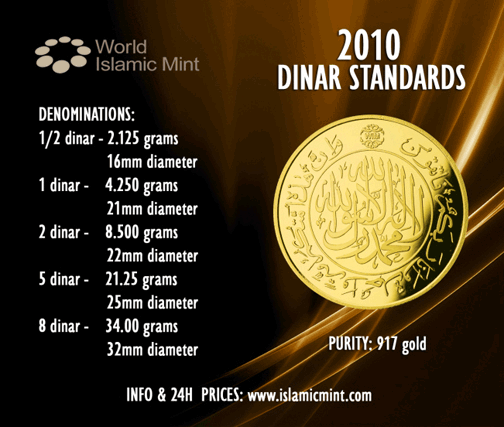
WIM dinar standards
WIM gold dinar standards

That standardization mattered because Muamalat is not a set of isolated contracts. It requires infrastructure. A coin becomes money only when it is widely recognizable, trusted, and usable in markets. Researchers discussing Dinar and Dirham usage repeatedly point to standardized weight definitions, such as the widely cited Dinar weight of 4.25g (22 carat), as a key condition for public acceptance and practical trade.

WIM and WITO were therefore designed as more than “organizations.” They were intended as a global platform for Halal money and trade that could operate independently of the Riba-based logic of modern monetary systems. The goal was not to lobby fiat authorities for permission, but to grow a parallel capacity: coins minted to a known standard, merchants able to price and accept them, and networks capable of sustaining real exchange without being trapped inside interest-based banking.

E-Dinar

Once the Gold Dinar and Silver Dirham re-entered circulation, Shaykh Umar faced a practical question that every serious monetary reform runs into: how do you scale real money in a world that runs on screens?

This is where E-Dinar emerged. It was developed as an internet-based payment and exchange system designed to let people transfer ownership of gold and silver electronically, while keeping the underlying money anchored in physical metal. In other words, it aimed to bring the Dinar and Dirham into modern commerce without surrendering them to fiat logic.

Contemporary descriptions of the system present it as fully backed: E-Dinar (gold) and E-Dirham (silver) were represented as 100% backed by physical bullion, and the account balances were framed as title to a precise weight of that gold or silver. This mattered because it positioned E-Dinar as the opposite of credit money. Instead of expanding purchasing power through debt, it attempted to facilitate payment by transferring measured ownership of an existing asset.

The initiative also reached digital commerce. A 2002 Wired feature notes that e-dinar launched in September 2000 as a Muslim-oriented interface to e-gold, and that Umar Ibrahim Vadillo held leadership roles within e-dinar and the Islamic Mint.

Academic writing on Gold Dinar usage in Malaysia discusses electronic payment systems, including E-Dinar, as part of the practical ecosystem around Dinar adoption, especially for payments where physical coins are inconvenient.

In short, E-Dinar was an attempt to solve a real constraint: preserving Halal money as real value while enabling modern transaction speed. It was one more expression of the same strategic direction in Shaykh Umar’s work: not “Islamic products” built on fiat foundations, but parallel infrastructure that makes Muamalat possible in lived economic life.

The Esoteric Deviation in Islam

By the time Shaykh Umar was challenging paper money and banking, he had already identified a deeper obstacle. Many Muslims were trying to “fix the economy,” but the underlying worldview had already been bent. Not by open disbelief, but by a slow drift of ideas and movements that presented themselves as Islamic while quietly changing Islam’s foundations.

That is the context for The Esoteric Deviation In Islam, his near 1,000-page study that maps the rise of esoteric and modernist currents across the last roughly 150 years, and the way these currents reshape belief, authority, and practice.

The book is not written as a polemic for spectators. It is written as a diagnostic for leaders. It documents how deviations form, how they spread through institutions, and how they produce “Islamic language” that keeps the outward form while altering the inward substance. In doing so, it aims to clear the ground for a return to Islam as it was lived and transmitted, rooted in the Madinan inheritance rather than modern ideological projects.

This is why the work matters to Shaykh Umar’s wider project. A community cannot restore Muamalat while its intellectual compass is distorted. Before you can rebuild the Suq, restore Zakat, and remove Riba from public life, you have to recover the criteria that tell you what Islam is, and what it is not. The Esoteric Deviation In Islam is his effort to provide that criterion at scale, with extensive documentation and a clear call back to orthodox principles.

Research and Presentations in Pakistan: bringing Muamalat into the courtroom

In Pakistan, the debate over Riba was never merely academic. It was a national question with constitutional weight, argued through decades of hearings and judgments, and pressed forward by citizens who wanted the courts to do what the Shariah demands. In that environment, Shaykh Umar’s contribution was distinctive: he did not arrive with another “Islamic finance model” that adjusts contracts while leaving the monetary system untouched. He brought a complete alternative, rooted in Muamalat, and he brought it in a form the judiciary could interrogate.

That is why his engagement with the Federal Shariah Court mattered. He participated as a scholar of Muamalat and as an expert on Shariah money, responding directly to the Court’s questioning and framing the real issue upstream: Riba is not only a clause hidden in contracts, but a system sustained by institutions, by banking, and by credit-money itself. The heart of his intervention was simple and hard to ignore: if the objective is to eradicate Riba, the process cannot stop at “interest-free products.” It must establish the halal alternative in full.

This same thrust appears clearly in the petition work associated with the case, presented as Muamalat: The Alternative to the Riba System Exists. Its opening premise is direct: “in trading there is the cure to Riba” and “trade is Muamalat,” and any serious attempt to eradicate Riba must begin by establishing what is Halal, not merely by rearranging what is Haram. It treats Riba as a system and therefore insists that the solution must also be systemic.

From there, the argument becomes constructive. The petition outlines Muamalat not as theory, but as a living civilizational model that historically included the institutions that make Halal trade workable: Suq, Waqf, and Bayt al-Mal, alongside Shariah money in Dinar and Dirham, and the contracts of Qirad and Shirkat. In other words, it frames the exit from Riba as an institutional restoration, not a branding exercise.

Shaykh Umar’s written answers circulated publicly alongside this court-facing work, reinforcing the same insistence: the question is not “how to Islamise the existing machine,” but how to replace a Riba-based order with Muamalat as a complete societal order.
For a detailed account of Pakistan’s Riba case and the wider legal landscape it sits within, see our case study The Pursuit of Riba-Free System in Pakistan.

Global Recognition and Influence
Engagement with Leaders and Scholars

Umar Ibrahim Vadillo has engaged senior leaders, scholars, and public figures across the Muslim world to advance the practical re-establishment of Muamalat as a complete socio-economic order. Across these conversations, his focus has remained consistent: uprooting Riba at its source, restoring Zakat to its correct legal function, and advancing the Gold Dinar and Silver Dirham as Thaman—so trade can return to the Suq as a protected public institution. Through dialogue and advisory work, these issues have moved beyond theory into public debate, institutional design, and policy-level discussion.

Shaykh Umar Vadillo meeting with Mahathir Mohamad
Selected engagements include:
  • Pakistan: Prime Minister Imran Khan — pathways to eliminate Riba from the financial system.
  • Türkiye: Dr. Necmettin Erbakan (Former Prime Minister) — monetary standards rooted in gold and silver.
  • Morocco: King Hassan II — restoring Zakat as a legal pillar tied to lawful money and just redistribution.
  • Malaysia: Dr. Mahathir Mohamad (Former Prime Minister) — monetary reform and Muamalat as an alternative economic direction.
  • Malaysia: Tun Daim Zainuddin (Former Finance Minister) — lawful money and the limits of fiat dependency.
  • Malaysia: Dato’ Sanusi Junid — restoring trade and Zakat through Dinar and Dirham.
  • Kelantan: Tuan Guru Nik Aziz — support for Dinar/Dirham initiatives in public life.
  • Indonesia: President Abdurrahman Wahid (Gus Dur) — Islamic economic principles for justice and stability.
  • Indonesia: Amin Rais — Muamalat-based policy and poverty reduction.

Impact

These engagements have helped strengthen serious consideration of a post-Riba economic order—one grounded in lawful money, public markets, and the institutional foundations of Muamalat.
Current Engagements
Blockchain and Digital Infrastructure for Public Systems

Umar Ibrahim Vadillo’s current work focuses on the digital infrastructure layer that sits beneath modern economies. His interest is not in speculative “crypto markets,” but in how nations can deploy secure digital rails for record-keeping, settlement, and institutional transparency.

A key reference point is the semi-centralized architecture exemplified by China’s Blockchain-based Service Network (BSN). This model aims to combine state-level oversight with modular, developer-led innovation, creating an ecosystem that can deliver security, auditability, and interoperability at scale. Within this direction, his work advocates national frameworks that improve trust in public systems and reduce dependency on opaque intermediaries.

United Awqaf Network

Umar Ibrahim Vadillo is also the founder of the United Awqaf Network (UAN), established to revive Awqaf as a living public institution rather than a dormant legacy structure. UAN’s aim is to strengthen Awqaf performance through modern infrastructure and governance tools, so endowments can operate with greater integrity, efficiency, and measurable social impact.

A core priority is transparency. UAN explores how distributed ledgers can support clear asset registers, auditable disbursements, and accountable stewardship, helping Awqaf serve their original purpose in society: sustainable provision for public benefit, protected from mismanagement and leakage.